Showing posts with label success. Show all posts

Monday, March 11, 2013

Adventures in Butter

My house had a surplus of unclaimed whipping cream recently, left over from a bridal shower that someone who doesn't live here had.
I made butter, of course.
The first time, I didn't take pictures because it was pretty spur of the moment, so I took pictures the second time around. You can pretend it was exactly the same, but the first time was better because I put a little bit of sour cream to "culture" the ultra-ultra pasteurized whipping cream, acting on the advice of Sally Schneider that cultured cream is far superior to sweet cream. It is. The sour cream was also left over from the bridal shower, though, and it had turned pink by the time I decided to make the second batch. And everyone was out of yogurt, and they don't really sell much creme fraiche in eastern Washington. So just pretend the second batch had culture in it. It looked the same anyway.
I made my butter in old pasta and jam jars (canning jars work as well, I hear). If you have a stand mixer or some kind of mixer thing that doesn't scare the crap out of you and spit stuff everywhere, you can just turn it on and leave it until it makes butter.

I started with about a cup of cream; it doesn't really matter unless you have a specific amount of butter you need. This made 4-5 tablespoons of butter. If you have cultured milk products, put 1 tsp of stuff in with the cream. If you're using creme fraiche, try half and half like the recipe says and tell me how it works. 

 It expands as it turns into whipped cream; this picture is about 5 minutes in.

 It takes a while to get through the whipped cream stage.

 This is for sure whipped cream at this point. Whipping cream goes through whipped cream to butter. It took I want to say 15 minutes of shaking, excluding the breaks I took (leave the jar in the freezer for breaks).

 
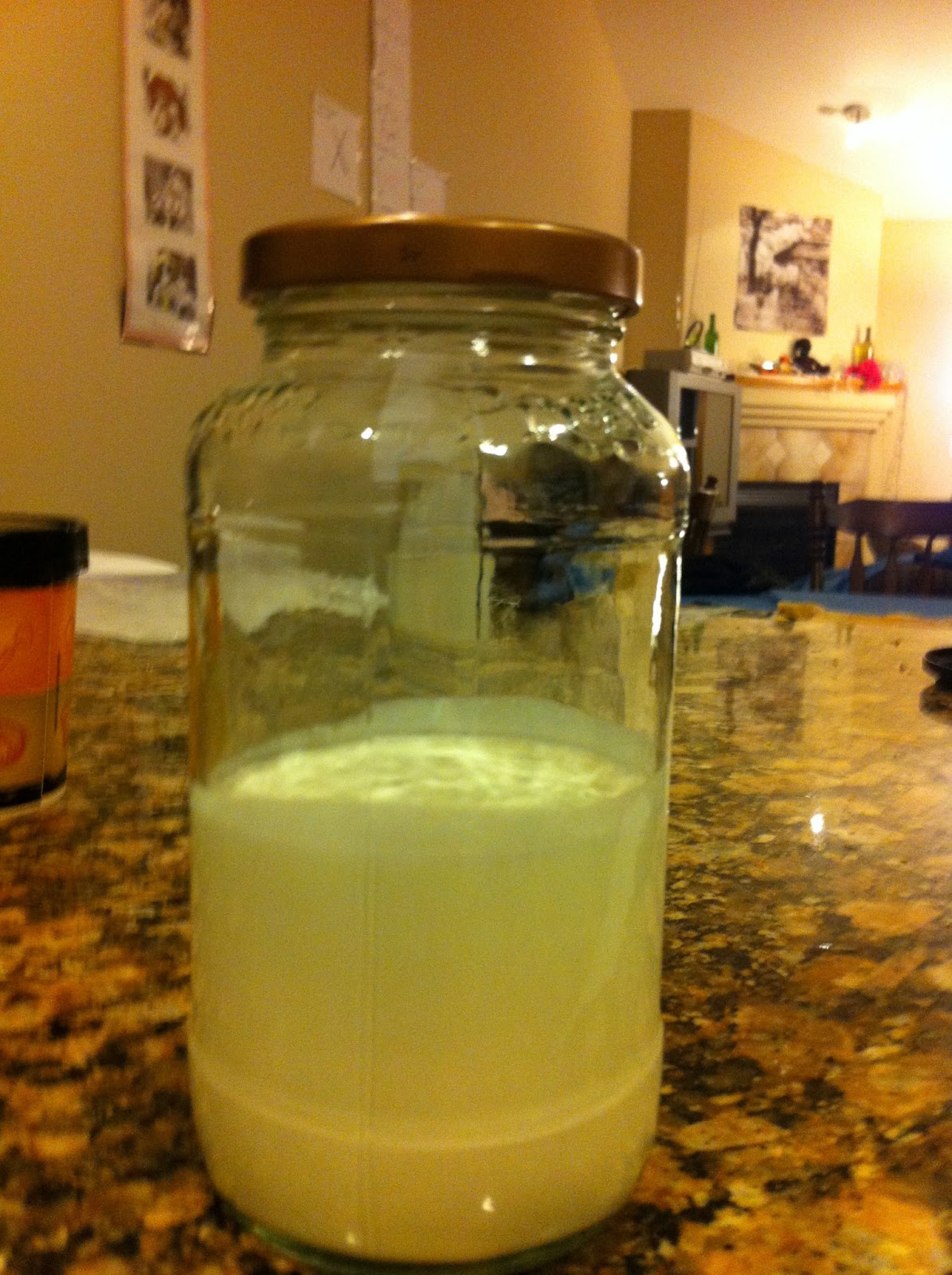
 I think it's butter here; the fat fell out of solution differently with normal whipping cream than with slightly cultured whipping cream. With the cultured stuff and a smaller jar, it sort of thumped out. This one kind of slid out without me noticing, but it was definitely butter when I tested it.

Butter and buttermilk
 Next, you strain out the buttermilk, which is fantastic and you should save that, and plop the butter into a bowl of ice water (no icecubes, please, but you can use them to make it cold). From there, you knead the butter to get the buttermilk out. A spatula is an excellent tool here.

You leave a lot of butter behind when you knead it, at least I do. The clean butter is placed on a plate and chilled for a bit in the freezer, and then you can add salt or put it in the fridge. If you used a little more than a cup and don't salt it, you should have the exact amount needed to make half of Smitten Kitchen's Favorite Buttermilk Biscuits. You'll also have the exact amount of buttermilk needed.
The biscuits are delicious.

Sunday, September 30, 2012

Italian Prune Butter

Remember those prunes I got?
Yeah, I made prune butter as soon as the crock pot was clean and I was awake. 
Here's the source: Eating Small Potatoes.
Here's what I used:
1 1/4 lb prunes (18 prunes)
Just about 3 oz sugar (approx 1/3 c)
1/4 tsp vanilla (actually about 1/3, but that measure doesn't exist, so I stuck with 1/4)
Here's the broken down ratio:
About 1/4 c sugar to 1 lb fruit, and 1/4 tsp vanilla per lb.

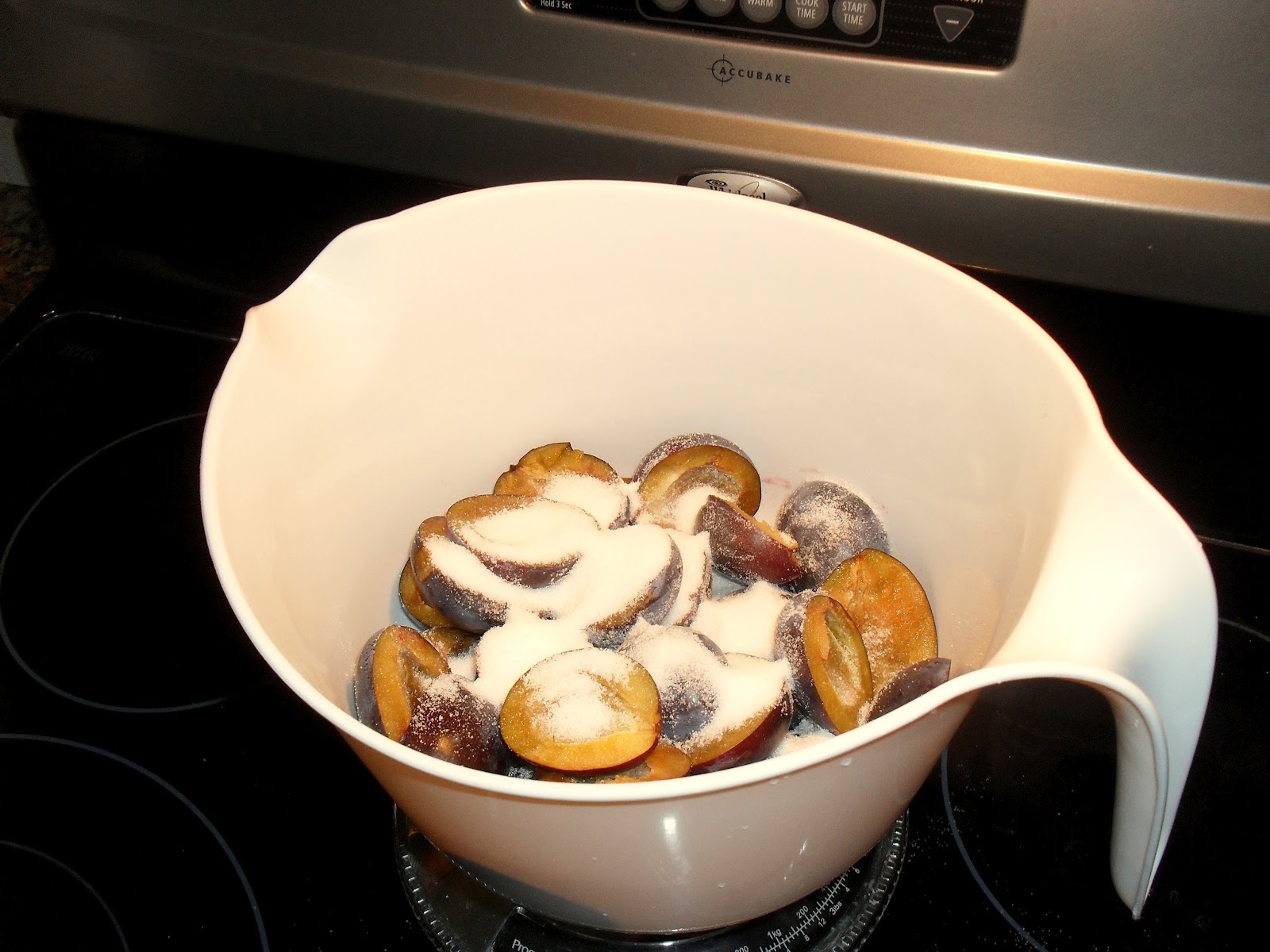
First, wash your prunes, halve, and pit them. Cut them into a bowl on a scale because you want to know how many prunes you used. End up counting the pits anyway.

Prunes!
Prunes halved and mostly pitted. They come out of the mix pretty easily if you can't get them out of the fruit itself.
 Second, work out the ratio of sugar from the website you found this recipe on. Decide that you'll use your scale to add sugar and not worry about tricky conversions between ounces and cups and pounds.
Add however much sugar you need. If you're using this website, put in 1/4 c sugar for each pound of prunes.

Prunes and sugar, tarting it up.
Prunes and about 3 oz sugar.
 Dump the mixture into the crock pot. Admire, and worry that the sugar will burn. Stir obsessively.

Prunes and sugar about to start cooking
Prunes and sugar in the crock pot. I was very anal about taking lots of pictures.
 The prunes will start making their own juice pretty much as soon as they get warm.  Feel relief, but still stir way too often.

Sugar and prunes gettin' busy.
The sugar has started to draw the juices out of the prunes.
 Become slightly enraged by the site of the crock pot with its lid on. Feel a deep, pressing need to remove it and observe its contents.
Resist this urge by going for a walk and then doing your housemate's workout DVD.

Crockpot with lid on drives baker insane.
This is the most maddening sight in the world. All I want to do is take off the lid and stir.
 Dance around the pot whenever you're not doing something else.
This is about a third of the way done. The skins are starting to come off and disintegrate, and the flesh is getting all smooshy.
NB: the flash on my camera was being dumb and made everything look much redder in the pot than it should have been. The flesh was a light yellow for most of the time while the juices were a purply brown that was pretty hard to distinguish from the black crock pot.

Prunes looking delicious
They're starting to stew in their own juices and make my pictures look funny.
 This is about half done. The flesh has almost formed a smooshy mass with some skins floating around and some juices still around the edges. By the end, you want those skins to be all the way dissolved into the smooshy stuff and no juice around the edge.

Mostly-cooked prunes
The fruits are all the way smooshified, with just some skins floating around.
 This is where I realized that I should probably have started this last night or woken up earlier. I don't have enough prunes to make a nice, thermally-stable butter that can sit in the crock pot overnight and not burn. I was thinking I would just set it to warm and deal with it in my mid-morning "lunch" break, but then I realized that I liked the taste and texture already.

Almost completely cooked prunes
This is more what the prunes looked like the whole time; but don't be turned off by the brown color. They are delicious.
 I added vanilla here. It adds a nice complexity to the flavor. I wouldn't recommend cinnamon, but if you have a thing for plummy things with a certain spice, go for it.
Then I let it sit for a few minutes and jarred it.

Homemade deliciousness in a borrowed jar.
The finished plum butter, in the ubiquitous used jam jar.
The butter that I got is less buttery and more jammy, with some half-dissolved skins still in it. It's tart, sweet, and tangy, with enough body to be a delicious spread. The vanilla blends well, but would not be required. I'd say that I got about 1 1/2 cups of butter; it might have gone down to 1 or 1 1/4 by morning.

EDIT: As a side note, I've decided that I NEED a tiny crock pot when I get my own place. I want a little one about half the size of A's so I can make 1-person jams and applesauces and suchlike. 

Wednesday, July 18, 2012

Oat Crepes

Teaser of finished crepe with fruit

I stole the idea of Oat crêpes from Well Fed, Flat Broke, but the execution is fully mine. You see, Emily's recipe calls for 1/4 c butter and FOUR EGGS. I don't have any eggs right now, and that's a lot of cornstarch eggs to be dealing with. So I took my usual recipe of flour, 1 egg, some milk, and a buncha salt and adapted it to oats.
Unfortunately, oats absorb a lot more water than flour, so I ended up needing tons of milk after I started making them. I've adapted the recipe slightly, but please adapt it further to your needs.

Ingredients

1 c quick oats
1 1/2 c milk (at least)
1 tbsp cornstarch/1 egg
1 tbsp oil
1 tsp salt (at least)

Procedure

Put your dry ingredients in the blender. I put my cornstarch in, but you don't have to if you've already mixed up your "egg".
Blender with whole oats and cornstarch
My blender is from the 70's, I think. Possibly the 50's. I got it at a yard sale.
 Blender that up. Shoving the oats gently down towards the blade with a spatula will keep things going.

Blender with ground-up oats

Once the oats are all smooth, add your wet ingredients: milk, oil, egg/"egg".

Blender with ground up oats and wet ingredients unmixed

Blender that up as well. Remember that the oats will absorb a lot of the milk, so don't add more oats until after it's sat in the fridge for at least half an hour. You WANT it to be really soupy.

Blender with blended oats and wet ingredients

Let sit in the fridge for half an hour or so. Then give it another go on the blender and add milk or oats as needed. Go small on the oats, though.
Then grease a pan and heat it on medium until it's pretty hot. Otherwise, your first crepe will be a pale, oily thing.
Pour about 1/4 c of batter into a small skillet and tilt gently in a swirl to get batter in a nice, thin circle. This should not be stressful.

A crepe in the pan

Ignore the crepe until the edges pull up from the pan (or turn golden brown if they're too thick to pull away) and the surface is mostly cooked through. Flip gently.
Very gently, with oat crepes. They're a bit floppier than flour crepes, and take a while longer to cook, so don't rush things like I did.

Broken crepe in the pan

Below is what a nice crepe looks like. Your pan is all warmed up and heating evenly, and you've destroyed enough crepes to be patient.

Nicely browned, whole crepe in the pan

The second side to cook will always be spotty and paler than the first's nice, golden brown. Don't let this bother you. These are not like american pancakes. If it really, really bothers you, get a crepe maker or something.

Second side cooked of a crepe

Fill or top your crepe with whatever you want: peanut butter, jam, whipped cream, nutella, greek yogurt, fresh fruit, all of the above, whatever. All are good. Combinations are great. I'll do cream cheese and jam sometimes, peanut butter and jam, greek yogurt and jam, etc. I guess you could use butter, but crepes are thin and a little greasy, so they don't really need it.
I always put the goodies on the inside and fold the crepe into thirds around the filling, but some do a tight roll, some do halves, and some fold the crepe into thirds and put the goodies on the outside. Whatever strikes your fancy.
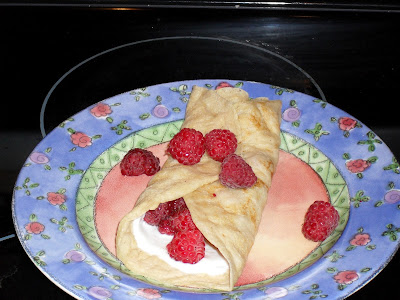
Filled crepe on a nice plate.
Fancy fancy crepe with greek yogurt and fresh raspberries from the community garden down the road.
I make crepes almost every Tuesday, usually in the evening, but that's because I love them so much. It's a very relaxing thing for me to do, especially since I usually have a lot due on Wednesday. It's a study break, a time to focus on nothing except the gentle swirl of the batter in the pan and the sizzle of cooking crepe. It's an exercise in patience, which I desperately need during heavy study times.
Also, be warned that this will make far too many crepes to eat by yourself (as will most recipes that claim to make 8. I think they want you to use a big pan or something). Invite your friends to share, or eat them for most of your meals for the rest of the week.
Monday, July 16, 2012

Successful Bread


Bread sponges are officially the best thing ever.
Teaser image of the bread you can make.
This light, fluffy bread was made with a sponge.

I found this post about how to make delicious bread from a sponge on Well Fed, Flat Broke quite a while ago and have been wanting to try it since I saved a blob of dough from the slightly unsuccessful if still delicious whole grain "Healthy Bread" from a while ago.
Just to clarify, a sponge here has nothing to do with cleaning and everything to do with letting yeast ferment overnight before putting it in dough. It's a lot like sourdough starter, but with store-bought yeast instead of sourdough starter.
I halved the recipe for my purposes, but it's an easy halving to do as long as you know that 1 tablespoon equals three teaspoons, or have a 1/2 tbsp measure. I'd never heard of one before, but my housemates have one. I love it so much.
Anyway, that was leading up to me telling you that I won't be posting the recipe, although I did take copious pictures. It's Emily's recipe with no changes, so go there and check it out.


Bread sponge just after mixing up.
It all starts with milk, flour, and yeast, and a blob of dough if you saved some from the last time you made bread.

Sponge ready for sitting overnight, all covered in plastic wrap and a towel.
I'm not sure why the sponge needs to be covered with plastic wrap and a towel; maybe for insulation?

Sponge all bubbly after 12 hours or so.
Fermenting happened!

Sponge after stirring in the yeast, water, and sugar mixture.
The sponge was all gloopy even after I added the yeast/water/sugar mix. I used agave, actually, and it worked great.

All ingredients incorporated into the sponge, which is now a dough.
The dough seemed dry, but it really wasn't.

Dough pressed into the bowl to show amount of dough.
I kept stirring the dough, then pressed it into the bowl for a prettier picture.

The dough, kneaded and oiled and waiting to rise.
This is the dough after kneading. I used about 3/4 c flour while kneading, then made a ball and used a little melted butter but mostly olive oil to grease the bowl.

The dough, doubled in size.
The dough rises really well in hot, humid weather.

The dough, pre-second rise in its pan.
The dough is pretty easy to work with; just smoosh it into a smooth log and plop it into a greased pan.

Very puffy dough after about five minutes in the oven.
I forgot to take a risen picture of the dough, so I snapped one about five minutes into the baking time. It rose about another two inches in the oven.

The finished, browned loaf cooling on a rack.
Ta da! I rolled my dough into a loaf. I don't recommend this method.

Loaf of bread looking artsy with a slice cut off.
Isn't it gorgeous? Other than the way it falls apart because I rolled it up and it didn't mesh.
My doughs always collapse and go dense. This was super successful, and I highly recommend the method, even though you have to plan ahead.